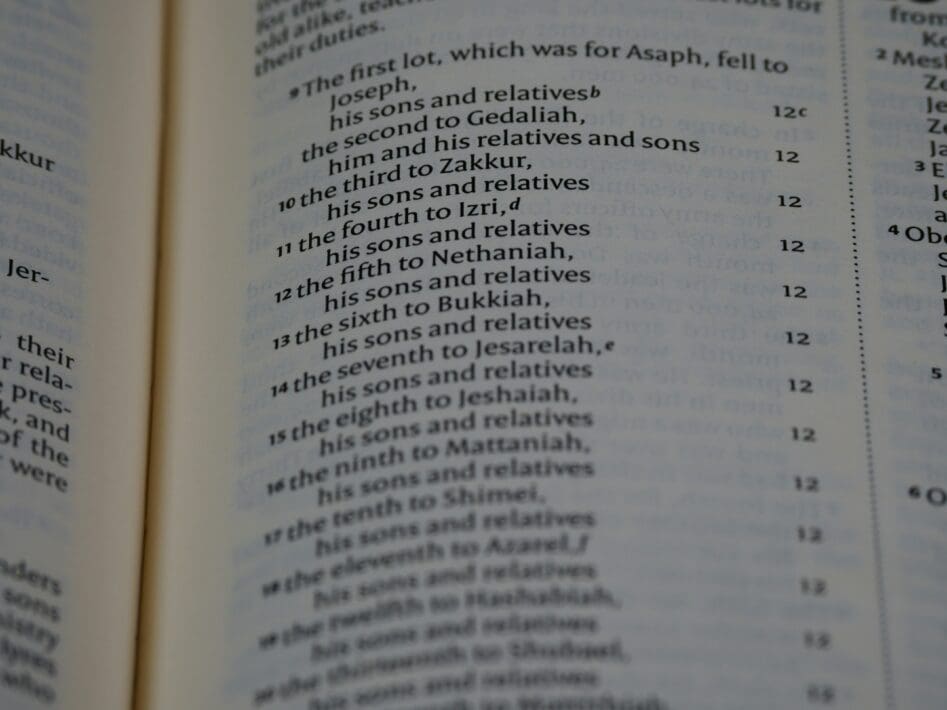
As I was reading through the sixty-eight verses of names given in Nehemiah Chapter 7 one Sunday morning, I began to wonder what I was doing. Of course, I knew that I was in the middle of reading names, some of which are almost impossible to pronounce correctly, but larger than that, I began to wonder if this was crucial to what I was trying to accomplish through the preaching of the text. The conclusion that I came to is, yes! Though some in your church may be tempted to nod off as they hear the number of sons Binnui had (Neh 7:15), I believe there is still great importance to preaching through lists of names and genealogies in Scripture. Let me give you three reasons why, as we specifically consider Nehemiah Chapter 7.
First, as a preacher, you must believe that “all Scripture is breathed out by God and is profitable for teaching…” (2 Tim 3:16). It is true that some passages may have more low hanging fruit so to speak when it comes to understanding and application, but that doesn’t mean you should skip over the more difficult texts. With that said, when you approach texts such as Nehemiah Chapter 7, you may have to dig a little bit deeper into the richness of God’s word. For if you skip over these types of texts, what prevents you from skipping over other texts that are debated or controversial? Furthermore, what prevents your people from wrestling with difficult texts in their own private reading? You must hold to every verse and mine the depths of every passage as it is God speaking to his people, through His Word.
Second, reading the names and genealogy of ancient believers connects your people to God’s bigger purposes. For example, the theme of Nehemiah is much bigger than God’s people building a wall. Yes, chapters 1-6 chronicles Nehemiah’s journey and his complications to getting the wall around Jerusalem rebuilt, but Chapter 7 clues your people into the fact that there is more going on here. The wall around Jerusalem was built to preserve a people. For without a wall, God’s people are left vulnerable in their daily devotion to Him, but also in their worship of Him, as the temple would be left open to any and every band of marauders who passed by. The wall wasn’t built for the sake of merely having a wall. It was built to preserve God’s people, of whom you see listed in Chapter 7.
Third, names and genealogies show your people that they are not alone in their faith. For example, there are 49,942 people accounted for within the gates of Jerusalem in Nehemiah Chapter 7. They have been set apart by God and assembled for the purpose of gathering around God’s Word together, as will be seen in Nehemiah Chapter 8. You and your people too, as New Testament believers, have been set apart and placed within the church to assemble around the word of God. This is how God works. He calls his people to Himself, to gather in His place, to worship Him. This is meant to form a glimpse of the heavenly gathering that your people are looking to. For, one day, all believers will gather with those from Nehemiah 7 in a new city, where the gates will never shut (Rev 21:25), whose designer and builder is God (Heb 11:10), and His glory will shine forever (Rev 21:23).
Though it may be tempting to skip over passages such as lists of names and genealogies because they seem mundane or even difficult to understand, you must scale the depths of God’s Word with faith, believing that all of His Word proclaimed can further equip the believer for every good work (2 Tim 3:17) through the power of the Holy Spirit (2 Cor 2:10-13). Therefore, preach the names and genealogies confidently, trusting that there is a purpose behind every text and that God will be at work through His Word.